Authored by Layla Yammine
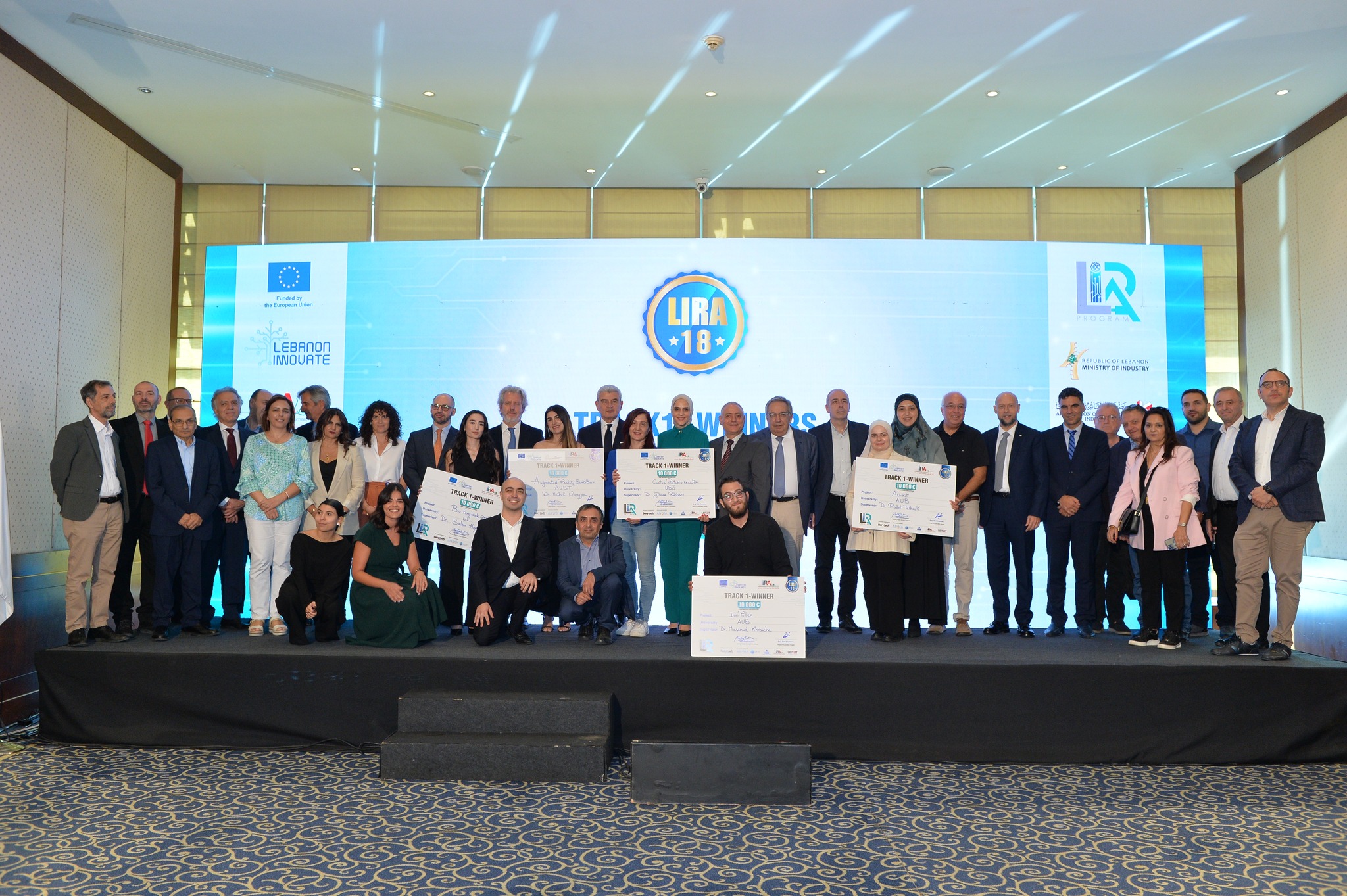
It is always refreshing and hopeful to see students and academics bring their innovations to life. Despite the country’s chaos and instability, Lebanon has always had one steady resource: the creativity of its students, who for generations have continued to give back to the country and its people. Several new, potentially groundbreaking projects were pitched at the LIRA forum in October 2025, held at Le Royal Hotel in Dbayeh, reflecting an ecosystem that steadily translates academic curiosity into market-ready products.
LIRA’s competition, operating under the IRALEB umbrella, has for the past two years, been run in close partnership with Berytech as part of the EU-funded Lebanon Innovate program. It functions as an institutional pipeline where they scout university projects, graduate research and early-stage prototypes; expose them to industrial challenges; and shepherd selected teams through bootcamps. The Lebanon Innovate team then oversees acceleration and incubation so that ideas can mature into viable companies, providing both financial backing and strategic framework that enable promising projects to advance. In parallel, the IRALEB Board of Trustees is proposing a fund for projects that address industrial innovation challenges, a track that involves collaboration with industrial partners to enhance new products, upgrade production lines, or develop entirely new lines of production.
The selection process remains rigorous and pragmatic. Outreach to universities yields dozens of applications; those shortlisted enter a focused bootcamp and pitch rounds. From roughly 89 initial submissions this year, 10 teams advanced to the live pitching stage and a smaller cohort moved into an intensive acceleration phase with Berytech experts before the final jury decided the winners. That acceleration combines market validation, product development, and IP strategy with hands-on support to build investor-ready pitch decks. But the essence of the event was the projects themselves. The pitches were not mere concepts but technically specific solutions with clear industry pathways and ready prototypes. Recent projects showcased a wide spectrum of innovation, ranging from the scaling-up of a freekeh-based craft beer to valorize Lebanese agricultural heritage (Elmir Brewing Company), to a cactus-inspired photobioreactor enhancing microalgae productivity for sustainable biofuel and biomass applications. Health and deep-tech innovations featured prominently, including a non-invasive blood-based early cancer detection kit (Axi-Kit), a wearable sweat-based ionic health monitor (Ion Pulse), an AI and VR driven platform for objective ADHD screening (Cogny) and a non-invasive continuous glucose monitoring system integrated with automated insulin delivery (DiaBEAT). Additional projects addressed inclusive smart-home control through brain-computer interfaces (Brainterpreter), augmented-reality tools for environmental education and disaster preparedness (AR Sandbox), bio-fungicide production using indigenous yeast as an alternative to chemical pesticides, and the sustainable synthesis of green metallic nanoparticles with applications spanning healthcare, food safety, water treatment and industry.
Collectively, these initiatives demonstrate the type of applied, high-impact research that LIRA and Lebanon Innovate are designed to support, where academically rigorous work is intentionally accelerated toward commercialization. The pitching sessions are deliberately short, intense and outcome-focused, aimed at turning academically sound work into commercial propositions.Berytech’s role is operational and catalytic: providing mentorship, incubation facilities, and network access that many university projects lack. Its collaboration with IRALEB continues to tackle a long-standing gap in Lebanon: the disconnect between academia and industry. For decades, research in Lebanese universities often stalled at the prototype stage, rarely reaching commercialization or industrial application. The LIRA framework, and now Lebanon Innovate, are working to close that gap. By creating structured pathways for collaboration, industry-sponsored challenges, and expert mentorship, the program allows students and researchers to view their projects through an entrepreneurial lens. In parallel, Lebanon Innovate helps researchers protect their intellectual property, connect with investors, and access incubation programs long after the competition ends.International funding and partnerships, including support from the European Union, have been crucial in enabling this pathway. Yet the true outcome comes from the meeting of immensely talented Lebanese students and industry stakeholders. What Berytech and IRALEB have done is channel external support into building long-term local capacity and innovation, rather than fostering dependency. Beyond financial backing, the program has opened doors to knowledge transfer, connecting Lebanese innovators to stakeholders, mentors, and technological hubs.
If there is a closing lesson from the LIRA Forum, it is structural rather than anecdotal. Talent and technical creativity have never been Lebanon’s shortage; what has been missing is the scaffolding to turn discovery into delivery. Programs like Lebanon Innovate, and institutions such as Berytech and IRALEB, are building that scaffolding step by step, a partnership that strengthens the local innovation pipeline and ensures that ideas conceived in Lebanese classrooms can mature into tangible products and startups. For a country battered by crisis, that slow construction may be the most hopeful thing of all.