

What happens when research leaves the lab and meets the real world?
That transition — where ideas turn into solutions, startups, patents, and partnerships — is where Technology Transfer Offices (TTOs) play a critical role.
Universities generate valuable knowledge every day, yet without dedicated structures, many research outcomes never move beyond academia. Technology Transfer Offices are the units within universities that help bridge this gap. They support researchers in protecting intellectual property, identifying commercial potential, and connecting with industry and investors — turning research into real economic and social value.
In countries with mature innovation ecosystems, TTOs are a cornerstone of university–industry collaboration and research commercialization. In Lebanon, however, these mechanisms have historically been fragmented or informal. Through the Lebanon Innovate program, Berytech is working to change this by building the policies, skills, and institutional systems needed for sustainable technology transfer.
Laying the Groundwork: From Strategic Vision to Intellectual Property
The journey began with a fundamental question: How can universities strategically manage, protect, and activate the knowledge they create?
As a first step, the Lebanon Innovate program worked closely with each participating university to define their research and innovation priorities. Through a comprehensive diagnostic and assessment of each university’s research and innovation landscape, tailored institutional roadmaps were developed. These roadmaps analyzed existing capacities, gaps, governance structures, and collaboration potential, and translated the findings into structured short-, medium-, and long-term action plans aimed at strengthening innovation performance, enhancing research valorization, and fostering stronger linkages with industry and international partners.
By establishing a shared vision and clear direction, these roadmaps ensured that subsequent interventions — particularly around IP policy development and technology transfer — were grounded in each university’s context, strengths, and long-term innovation objectives.
Building on this strategic foundation, the program then focused on strengthening the institutional and regulatory framework required to support innovation. This is where Intellectual Property (IP) policies became a critical starting point.
As part of the Lebanon Innovate university track, eight Lebanese universities received tailored support to develop or enhance their IP policies. This process concluded with the delivery of eight IP policies, aligned with international best practices and standards, laying a critical foundation for future technology transfer and commercialization activities.
Moving from Policy to Practice
With the policies in place, the focus shifted from design to activation and implementation.
In November 2024, Berytech launched the first structured monitoring round through one-on-one follow-up meetings with beneficiary universities. These discussions assessed the status of IP policy adoption, identified remaining internal approval steps, and explored how institutions were progressing toward implementation.
Universities reported solid progress, with several policies undergoing internal legal review or awaiting board-level approval. Importantly, at least four universities had already progressed toward activating and publishing their IP policies, while others had begun integrating IP considerations into their broader innovation and technology transfer strategies.
Beyond formal adoption, universities also reported progress in implementing their innovation roadmaps. Early actions included internal awareness-raising activities, inventor support mechanisms, prior art searches, and early-stage technology development initiatives.
While some institutions highlighted administrative procedures or competing priorities as factors affecting timelines, all confirmed their commitment to advancing the recommended steps.
A second monitoring exercise completed by October 2025 provided an updated overview of progress across participating institutions, including the maturity of IP policies, the establishment of TTO structures, and the appointment of dedicated technology transfer staff.
Designing the Engine: Structuring Technology Transfer Offices
With IP frameworks taking shape, the focus shifted toward operationalization.
In November 2024, Berytech launched a dedicated activity focused on the design and structuring of Technology Transfer Offices (TTOs), supported by its in-house consultant Dr. Mohab Anis.
A call for applications was launched in December 2024, targeting the eight universities that had completed the earlier phases of the Lebanon Innovate university track, ensuring continuity and institutional readiness.
Berytech supported each university in designing its TTO structure, translating policy and strategy into operational models. Through tailored one-on-one coaching sessions, universities were guided to contextualize the Technology Transfer Body of Knowledge (TTBOK), refine implementation roadmaps and KPIs, address institution-specific challenges, and align timelines with their broader innovation strategies.
Tools, Coaching, and Readiness to Implement
Each participating university received two core, customized deliverables:
- A Technology Transfer Body of Knowledge (TTBOK)
- A Technology Transfer Operational Toolbox Guide
These resources provided practical guidance, templates, and step-by-step methodologies to support the design, setup, and operationalization of TTOs. With the delivery and validation of these tools, all eight universities were equipped to initiate the establishment of their Technology Transfer Offices.
From Design to Capacity Building
To translate these structures into practice, the programme introduced targeted funding mechanisms, enabling universities to begin implementing their TTOs in line with the developed structures and guidelines. In parallel, capacity-building activities were rolled out to strengthen the skills of TTO and relevant university staff.
Following completion of the design phase, Berytech continued coordination with project partners to support implementation. Universities were invited to apply for TTO establishment grants, managed by IRI, and to participate in capacity-building activities for TTO staff, delivered by EBN.
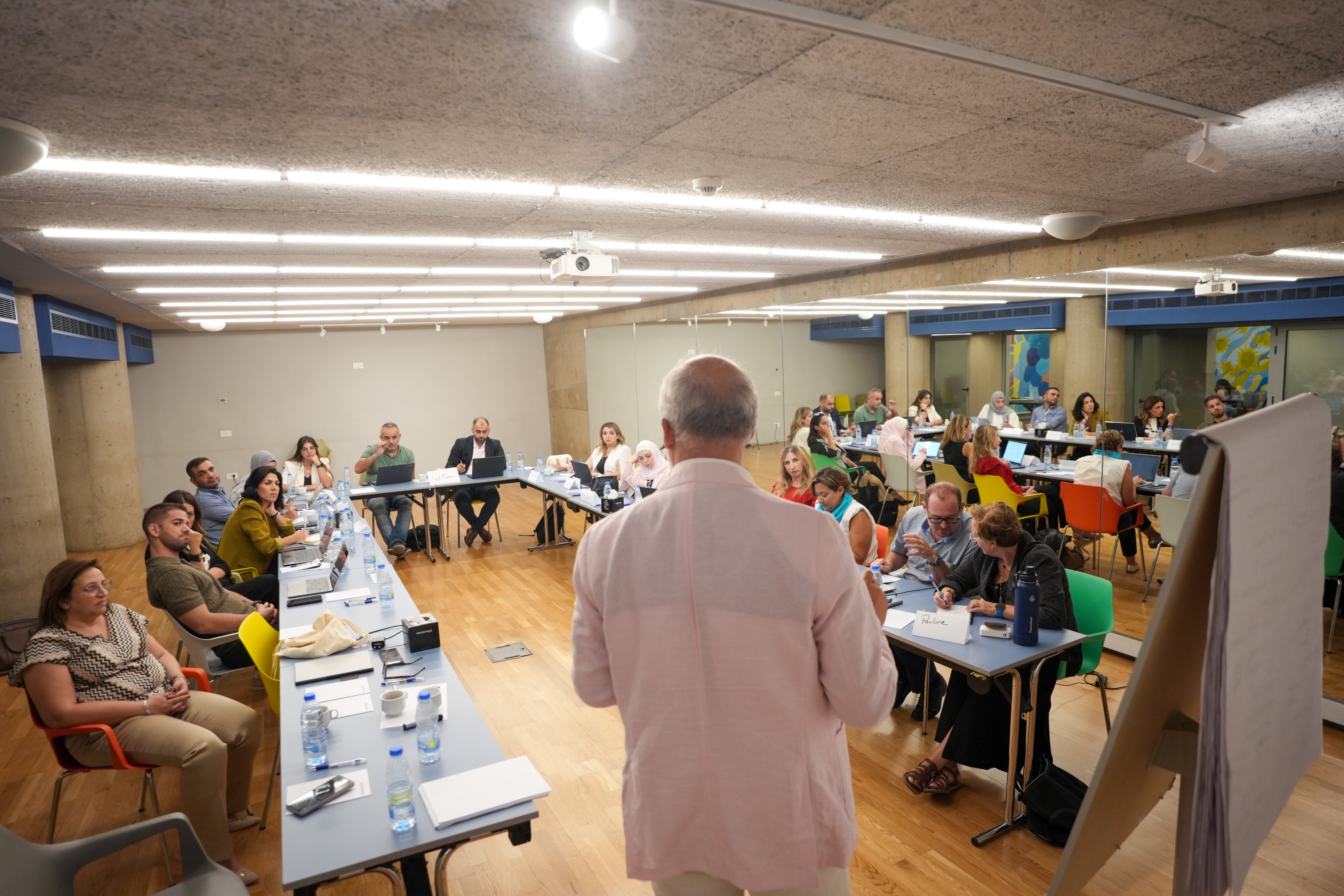
A dedicated training programme was subsequently implemented to strengthen the operational and strategic capacities of TTO staff. The five-day in-person training, held in Beirut from 15 to 19 September 2025, brought together 19 TTO staff and innovation officers from seven Lebanese universities.
The training combined expert-led sessions, practical exercises, peer exchange, and European case studies aligned with EU|BIC best practices. Core topics included IP fundamentals and patent drafting, patent search methodologies, licensing and IP contracts, technology readiness, spin-off creation, and university–industry collaboration models.
Building a Community of Practice
A key highlight was a networking session connecting TTO staff with the community of IP lawyers previously trained under Lebanon Innovate, fostering collaboration between universities and legal experts to support IP protection and commercialization.
Follow-up online sessions planned for late 2025 will further deepen learning on advanced topics such as patenting strategies, spin-off creation, and technology marketing. Training materials will also be integrated into the Lebanon Innovate Platform, ensuring long-term access and sustainability.
Laying Foundations for Sustainable Technology Transfer
By combining strategic vision, policy development, institutional structuring, targeted funding, and human capacity building, Lebanon Innovate has laid solid foundations for sustainable technology transfer systems in Lebanon.
These efforts strengthen universities’ innovation management capacities and contribute to a more connected, impact-driven national innovation ecosystem — where research is not only created but effectively translated into value for society and the economy.